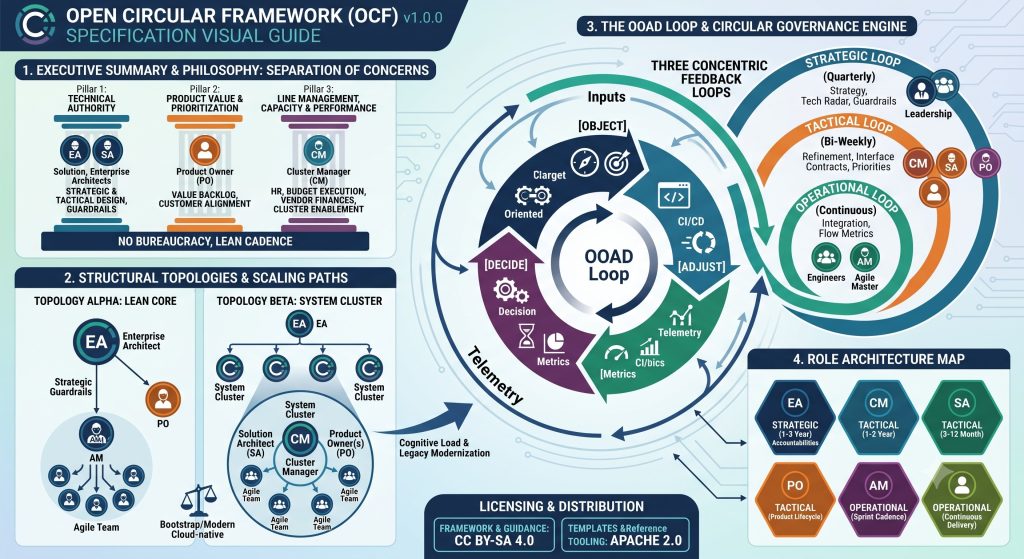
The Open Circular Framework (OCF) is an open-source, architecture-led IT scaling framework designed for modern, continuous-delivery organizations. OCF focuses exclusively on IT delivery and software engineering. It systematically strips away non-IT corporate overhead, excessive administrative bureaucracy, and paywalled certification schemes, substituting them with clear architectural guardrails, a lean operational cadence, and explicit structural alignment with robust, industry-standard enterprise architecture practices.
In large enterprise environments, scaled IT initiatives frequently fail at the line management boundary. Traditional agile frameworks often assume there is a formal corporate hierarchy or try to replace line management with abstract governance roles, creating operational friction and career progression deadlocks. By explicitly introducing the Cluster Manager, OCF bridges the gap between agile team autonomy and formal corporate hierarchy.
OCF achieves operational clarity by strict separation of concerns across three core axes:
- Technical Authority: Owned exclusively by Solution and Enterprise Architects.
- Product Value & Prioritization: Owned exclusively by Product Owners.
- Line Management, Capacity & Performance Governance: Owned exclusively by Cluster Managers.
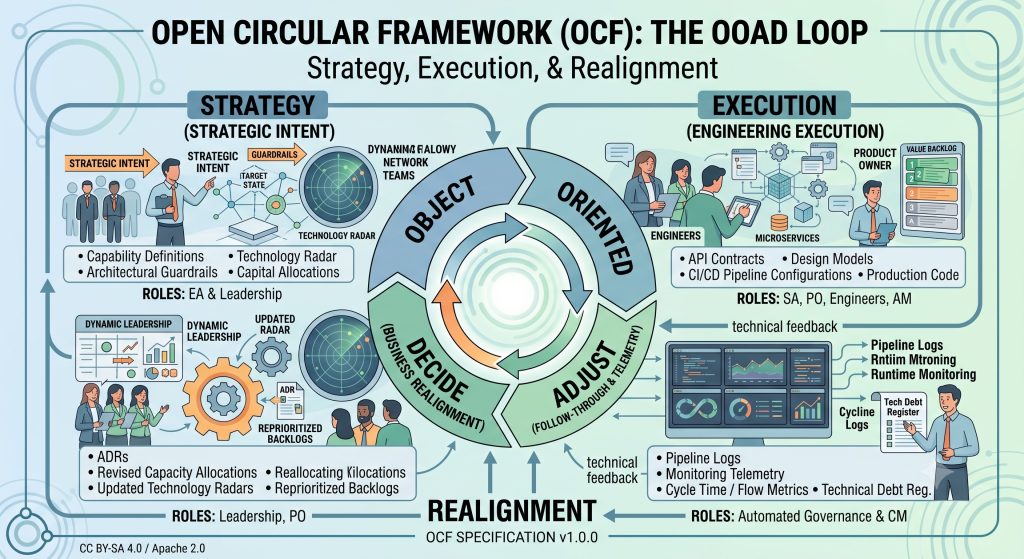
The OOAD Loop: Strategy, Execution, & Realignment
To ensure continuous operational flow and empirical governance, OCF embeds the OOAD (Object, Oriented, Adjust, Decide) loop as its core decision engine. This framework directly maps classic strategic management principles (Plan, Do, Check, Act) into modern, continuous-delivery software engineering.
- Object (Strategic Intention)
Definition: Defining concrete business capabilities, domain boundaries, and target architectural states.
Mechanism: The Enterprise Architect, working with executive leadership and Cluster Managers, establishes target capabilities, security postures, compliance boundaries, and budget envelopes.
Artifacts: Capability Definitions, Architectural Guardrails, Technology Radar, and Cluster Capital Allocations. - Oriented (Engineering Execution)
Definition: Translating strategic objects into working software through rigorous engineering practices.
Mechanism: The Solution Architect designs technical interfaces and data contracts. The Product Owner prioritizes functional user stories. Engineers build, test, and deploy polyglot code through continuous integration pipelines, facilitated by the Agile Master.
Artifacts: API Contracts, Design Models, CI/CD Pipeline Configurations, and Production Code. - Adjust (Follow-Through & Telemetry)
Definition: Continuously monitoring, measuring, and verifying real-world software performance against strategic and operational goals.
Mechanism: Following through on execution via automated governance, telemetry, and metrics. Automated pipeline checks provide instant technical feedback. Simultaneously, the Cluster Manager tracks delivery throughput, run-rates, and team cognitive load.
Artifacts: Pipeline Logs, Runtime Monitoring Telemetry, Cycle Time/Flow Metrics, and Technical Debt Registers. - Decide (Business Realignment)
Definition: Evaluating telemetry to make informed capital, architectural, and business shifts.
Mechanism: Leadership uses empirical telemetry to evaluate and steer. If technical debt inhibits flow, capacity is reallocated to refactoring. If market conditions shift, the PO reprioritizes the backlog within current guardrails.
Artifacts: Architectural Decision Records (ADRs), Revised Capacity Allocations, Updated Technology Radars, and Reprioritized Backlogs.
Role Architecture
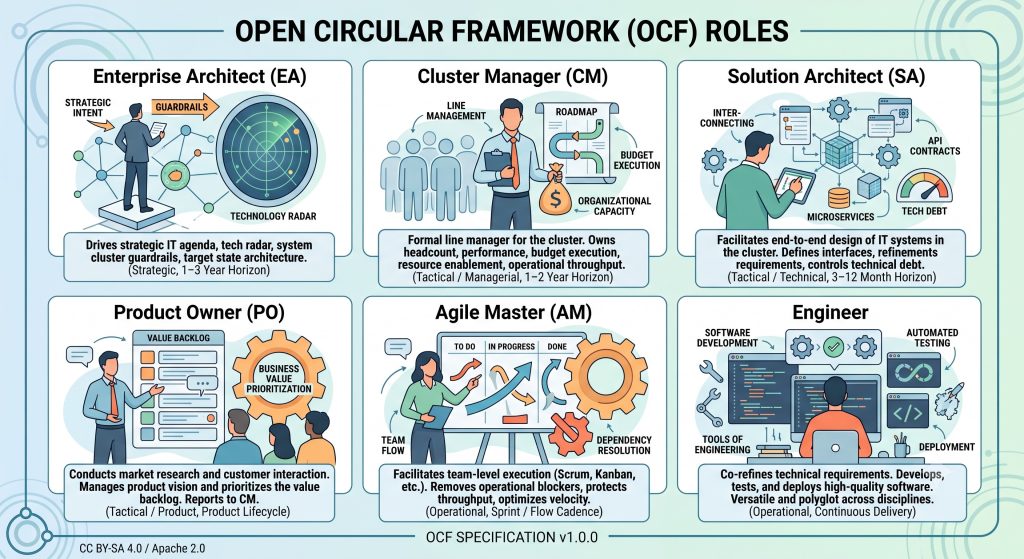
To ensure OCF integrates natively into existing enterprise repositories without introducing proprietary jargon, all six core roles map directly to formal organizational and architectural operating tiers.
| Role | Operating Tier | Core Accountabilities | Functional Scope |
|---|---|---|---|
| Enterprise Architect (EA) | Strategic(1–3 Year Horizon) | Drives strategic IT agenda, technology radar, system cluster guardrails, target state architecture, and capital allocation inputs. | Cross-Cluster Strategy, Inter-domain Boundaries, Standards Definition. |
| Cluster Manager (CM) | Tactical / Managerial(1–2 Year Horizon) | Formal line manager for the system cluster. Owns headcount, performance management, budget execution, resource enablement, and operational throughput. Line manager for POs. | Organizational Capacity, HR, Vendor Financials, Escalation Resolution within Cluster. |
| Solution Architect (SA) | Tactical / Technical(3–12 Month Horizon) | Facilitates end-to-end design of IT systems in the cluster. Refines requirements, defines interface contracts, and controls technical debt. Must have a deep software engineering background. | Solution Design, Tech Stack Selection, API Contracts, Code Quality Governance. |
| Product Owner (PO) | Tactical / Product(Product Lifecycle) | Conducts market research and customer interaction. Manages product vision and prioritizes the value backlog alongside the AM. Reports hierarchically to the Cluster Manager; can span multiple teams. | Business Value Prioritization, Stakeholder Management, Requirements Definition. |
| Agile Master (AM) | Operational(Sprint / Flow Cadence) | Facilitates team-level execution (Scrum, Kanban, or hybrid). Removes operational blockers, protects team throughput, and optimizes velocity metrics. | Team Flow, Dependency Resolution, Process Coaching, Operational Cadence. |
| Engineer | Operational(Continuous Delivery) | Co-refines technical requirements with SAs. Develops, tests, and deploys high-quality software. Versatile and polyglot across engineering disciplines. | Software Development, Automated Testing, Deployment (CI/CD), Local Design. |